
Take-make-waste. Since the beginning of the industrial revolution, this is the approach most countries have developed to operate today. Raw materials are collected, transformed into products which are used briefly, and then thrown away. This is the linear economy, a model in which value is created by producing and selling as many products as possible. As a result of this system, before a product reaches any sort of consumer this economic chain produces enormous amounts of greenhouse gases such as carbon, methane and nitrous oxide. Half of the total greenhouse gas emissions globally come from the extraction and processing of raw materials. In addition to this, when waste is the end point the world’s ecosystems are threatened by waste buildup of all kinds, from plastic waste to food waste.
As we become more aware of the ways in which linear economies affect the earth as a whole, efforts are being made to transition toward a circular economy. In contrast to a linear economy, a circular economy is a system of closed loops that ensures raw materials, components and products lose as little of their value as possible. Rather than value being created by producing and selling as many products as possible, a circular economy is focused on positive society-wide benefits, seeking to separate economic growth from the consumption of finite resources. Going past the performative acts of simply attempting to reduce the negative impacts of a linear economy, building a circular economy involves making systemic changes that provide benefits to the environment and society while also generating business and economic opportunities.
In order for the world’s economies to become circular, it will require total participation by individuals, governments, and businesses. Every entity must be on board in order for effective change to occur. Understandably for many organizations, changing from the status quo takes considerable risk and as a result many have been tentative to make firm commitments or take any substantive steps toward change. However, this is certainly not the case for JD.com. In the latest of many green initiatives, China’s largest retailer worked with Kearney and ATRenew to develop and release the “2021 Circular Economy Research Report.” According to the report, the post-consumption electronic waste that is generated in big cities has the potential to be a valuable source of metals if that waste is instead fed into a recycling loop, creating considerable economic and environmental benefits.
According to data from JD and ATRenew’s user survey and second-hand good sales data over the last four years, simply promoting trade-in services can play a significant role in putting idle electronic products such as mobile phones into the circular economy. In 2020 alone, by closely collaborating with JD.com and other retailers ATRenew was able to recycle more than 23 million second-hand products for resale or disposal in an environmentally responsible way, cutting down on 36.1 tons of e-waste. The report emphasized e-waste recycling’s ability to reduce heavy metal and battery pollution in addition to recovering valuable metals such as palladium, copper, silver and gold, but it also revealed some of the reasons consumers may not have participated yet in programs to return their electronic goods. Nearly half of participants said they didn’t have access to a convenient way to dispose of their outdated electronic devices, and over a third had three or more idle electronic goods at their home. In order to ramp up consumer electronics recycling, in July of 2021 ATRenew launched a pilot program called the “integrated city model,” bringing together resources and capabilities of cities, merchants, retailers and customers to increase the rate of circular economy adoption in China.
At the same time, JD.com announced a new five-year low-carbon program in 2021, pledging to invest one billion yuan in green supply chain construction, in addition to increasing its carbon efficiency by 35 percent. Additionally, JD Logistics––the logistics arm of JD.com––became the first Chinese logistics company to join the Science Based Targets initiative (SBTi) in 2019, setting a firm target to cut its carbon emissions in half and build a massive rooftop photovoltaic (PV) power generation ecosystem, all by the year 2030. In 2021, the company published their first ESG sustainability report, a voluntary initiative that discloses the company’s efforts and achievements in environmental, social, and governance aspects. This detailed report is a way for organizations to show complete transparency, paving the way for concrete goals and transparent steps toward the future.
As of November 2021, JD has already finished installing the PV power generation systems at 12 intelligent industrial parks. The PV system at Asia No. 1, JD’s fully automatic warehouse in Shanghai, can generate 3.11 million kWh per year for the office during the daytime and new energy vehicles (NEVs) at night. Additionally, the PV power generation allows logistics equipment to operate in the dark, significantly reducing energy consumption as a result. Testing has indicated that 2283 kWh a minute could be saved as a result, the same amount of energy a household typically consumes in one and a half years. According to calculations, by the end of 2021 the total production capacity of JD’s PV power generation system will be 100 megawatts, enough to provide 50,000 households a year’s worth of energy. By 2024, they predict capacity will have reached 1000 megawatts, making green energy contribute to 85 percent of its intelligent industrial parks.
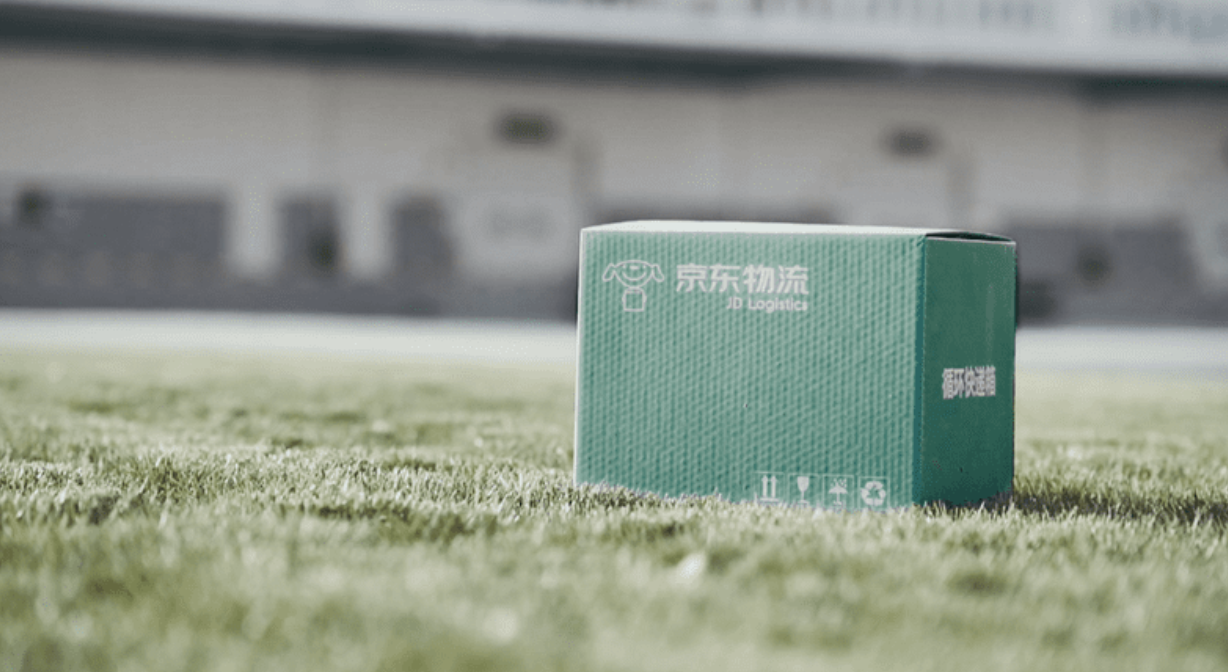
As an e-commerce website with one of the most advanced in-house logistic networks in the world, JD.com has consistently searched for ways to reduce their carbon footprint when it comes to package delivery. In 2015 the company conducted extensive research on how to reduce the amount of tape and packaging used in their facilities. By reducing the width of their tape from 53mm to 45mm, JD was able to save 400 million meters of tape by 2020, enough to circle the equator ten times over, and by making warehouses paperless it has saved over 13,000 tons of paper. Over the past four years they have also launched their Green Stream Boxes in over 30 cities across the country. The boxes are made of recyclable materials, have no need for packing tape and can be reused more than 50 times. Additionally, JD Logistics has dispatched over 12,000 new energy vehicles since 2018 into more than 50 cities in China, reducing at least 120,000 tons of carbon dioxide emissions per year.
At JD Technology, it has been working to develop ways for small and medium-sized enterprises to reduce their own carbon footprints and move toward a circular economy. Its blockchain-based digital contracting service has assisted in managing over four billion contracts for more than 500,000 enterprise users to date, and with an average contract using 10 pieces of A4 paper the platform has saved 40 billion pieces of paper so far, equivalent to saving 13 million trees and reducing more than four million tons of carbon dioxide emissions. Enabled by digital certificates and blockchain, the service makes sure that all parties in a transaction can share the same view of a live contract, and every step and revision of the contract is recorded, creating a tamper-proof audit trail. In this way, small and medium-sized enterprises can ensure security, lower costs and move their business in a more sustainable direction.
Founder and President Richard Liu has said that JD.com’s vision is to become “the most trusted company in the world” and their mission is to be “powered by technology for a more productive and sustainable world.” Indeed, the circular economy is one that meets at the intersection of productivity and sustainability, driving economic growth in a way that ensures the preservation of the planet and its resources.